I agree that leadership is influence. But I think influence alone is not a sufficient definition.
People can be influential and still not be leaders. For example, someone could run into a crowded theater and yell, “fire,” and influence everyone to take drastic action. But that person is not acting as a leader. They have influenced others, but they have influenced badly, and with no thought for the lives of others.
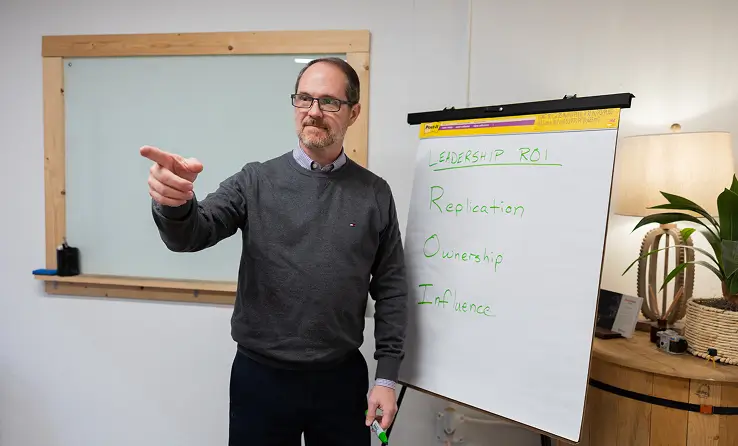
In my own three-word definition of leadership, I add two other important characteristics that make the influencer a true leader. I’ll describe each of these words one at a time (in reverse order) to create the acronym ROI.
R stands for Replication, O is for Ownership, and I is for Influence.
I stands for Influence
O stands for Ownership
The second letter in the ROI definition of leadership is Ownership. You are not a leader until you take ownership of the outcomes of your influence. In the theater example, the person yelling fire takes no ownership of (and does not accept accountable for) the actions that other people took based on their influence. A true leader takes ownership of everything that happens from their influence—good or bad.
Who owns the failure of performance when employees don’t do what is asked or don’t do it correctly? The leader. True leaders understand that they are 100% responsible for everything that happens in their organization. They take ownership for the actions of their direct reports. Even if those actions were wrong, misguided, or not done to quality, the leader must own the outcomes.
What if you have no positional authority in a relationship—are you still responsible to own the outcomes of that relationship? If you want to be a leader, then the answer is yes. Leaders will continue working on their influence until they are getting the results that they need.
Part of our work is to teach middle leaders how to influence laterally, to lead others who are not directly under their supervision. Even if they aren’t getting the cooperation, collaboration, or information they need from lateral peers, they take ownership of the outcomes of their influence instead of blaming others.
Ownership is critical—without it you only have an influencer and not a leader."
R stands for Replication
The third letter in the ROI definition of leadership is Replication. It’s my conviction that you can’t call yourself a leader until you have helped to develop another leader.
Leaders are not just about the work of accomplishing tasks, influencing people, and taking ownership of the outcomes. Leaders know that for the organization to sustain its performance over time, you have to develop leadership at every level. Leaders are constantly mentoring, coaching, and developing others around them.
There are two reasons why a leader cannot be successful until they have developed other leaders. The first is that a single, omni-competent leader is a bottleneck for the whole organization. The second is that the purpose of human organizations is not just the production of goods and services, it’s also the growth and development of people in the organization. Employees are investing years of their lives at work, and companies that do not build the capacity of their people are failing to hold up their side of the bargain.
The priority on developing human potential is one of the most basic tenets of servant leadership. Robert Greenleaf, widely recognized as the father of the modern servant leadership movement, said the best test is: “Do those served grow as persons? Do they, while being served, become healthier, wiser, freer, more autonomous, more likely themselves to become servants?” Leaders understand the expectation and responsibility to develop other leaders as central, not peripheral, to their role.
Of course, three words cannot fully define the complexity of leadership. Two of my favorite professors co-authored a scholarly definition of leadership that stretched to 14,000 words. But I do hope my three-word definition of leadership provides a window of clarity for what it means to lead as well as a way for you to measure your own leadership ROI.