You don’t have to lead for very long before you run into your own weaknesses.
Whether you saw the weakness in yourself or someone else pointed it out to you (maybe in the comments of a 360 review), you are now looking squint-eyed at an obstacle to your success.
Assess your Situation
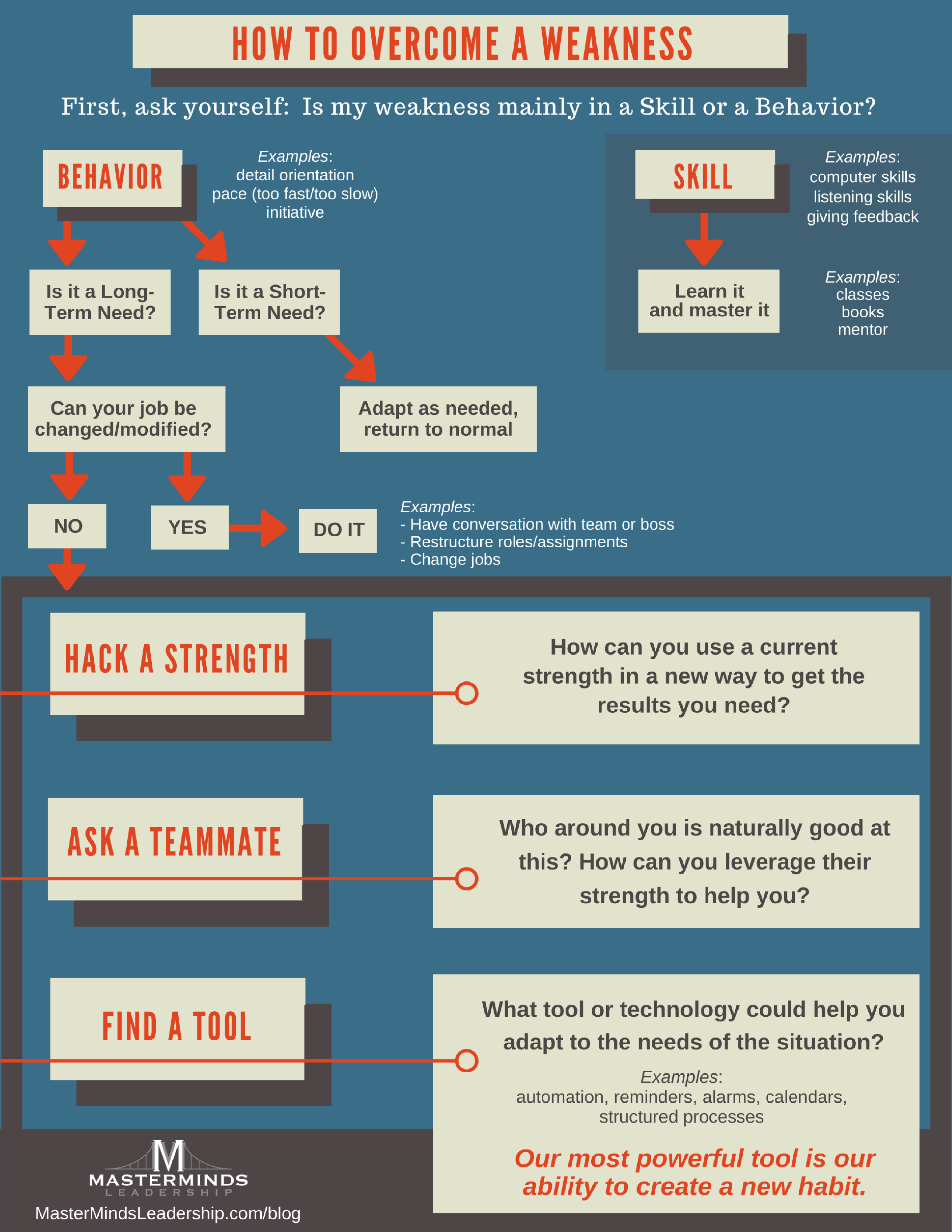 It makes a difference what kind of weakness you want to overcome. If your gap is a skill or competency, such as active listening or proficiency in Excel, then you can learn it and eventually master the skill.
But if the weakness is rooted in your behavioral profile, like overlooking details or taking too long to make a decision, you may not be able to change through effort or learning.
The downloadable infographic illustrates how to assess the situation around your weakness.
We’re going to focus on the common scenario where you can’t change jobs or change responsibilities in your role, but you still need to overcome a weakness in an area that is constantly present.
Since the root wiring of your personality is very difficult to change, you have three options for overcoming that kind of weakness: hack a strength, leverage a teammate, or find a tool.
The short, real-life anecdotes below show how leaders used these options to get the results they needed.
#1: Hack a Strength

I was coaching an executive leader who had received feedback from the CEO that he was not flexible enough when responding to problems or changes and was too easily overwhelmed.
When I reviewed the leader’s DISC profile, it became clear that stability, consistency, and careful planning were his core strengths. No matter how hard he tried, he was never going to transform himself into a flexible, quick-thinking problem solver. So instead of wasting energy trying to change his root wiring, we looked for a strength we could use in a new way to address the gap.
We analyzed his areas of responsibility and found that there were only about five types of problems that he routinely faced. While they could not be predicted as to when they would occur, they were common enough to be predictable once they showed up.
I asked the leader: how hard would it be for you to write up contingency plans for each of these five types of problems? While that kind of work would be extremely tedious for me (I am not naturally drawn to details), it was easy for him. He actually smiled and started rattling off different plans and solutions.
By hacking one of his strengths, he created a viable alternative to flexibility and quick-thinking—one that worked for him.
To hack a strength, ask yourself: How could I use a current strength in a new way to get the results I need?
#2: Ask a Teammate

Another president kept hearing from his team that he was too quick to commit to new ventures without considering the implications. Every time he said yes to a new opportunity, everyone had to scramble to adjust their priorities and either abandon or postpone existing projects.
The president’s wiring was a positive, can-do attitude that caused him to overlook potential time conflicts and underestimate demands. He was unlikely to make significant progress in his ability to assess the impact of new ideas on his staff.
One of his senior team members, however, was brilliant at logistics and could quickly analyze what capacities would be needed to successfully engage an opportunity. The president began to leverage her ability by postponing any new “yes” until the two of them could talk.
To leverage a teammate, ask yourself: Who around me is naturally good at this? How could I leverage their strength to help me accomplish my goals?
#3: Find a Tool

Americans are a little obsessed with our tools and technology, so you are probably already using this approach. Not a morning person? Set an alarm (a technology) and down a cup of coffee (a chemical tool). Forgetful? Set a reminder on your phone. Procrastinated on a gift? Select rush shipping or print out a gift card.
Leaders can take this option a step further by using tools and technology to overcome weaknesses. The available tools are endless, including apps, reminders, alerts, and automation. But don’t forget about simpler tools like sticky notes or written, structured processes.
One of the most powerful tools leaders have is the human ability to create new habits. The tool of habit-creation is so potent that it deserves a separate discussion.
To use a tool, ask yourself: What tool, technology, or new habit could help me adapt to the needs of my situation?
Combining Strategies
When a weakness affects a mission-critical area, you can combine all three strategies for maximum effect.
I admire people who are always prepared, and I value being prepared for meetings and presentations. But my natural strength is spontaneity and thinking on my feet, so I have trouble disciplining myself to prepare.
Because the behavior of preparation is so important to me, I use all three options to overcome a weakness.
I hack my strengths of foresight and my relational orientation by asking a team member to participate in a whiteboard session with me and talk through scenarios out loud. I end up being much more prepared than if I had tried to force myself to sit down alone (something else would always seem more urgent).
I leverage a teammate to do some advance research and prepare materials or at least a draft in advance. That helps me get over my initial resistance and build momentum.
I use a tool of my shared work calendar and a defined process for my assistant. For every important meeting, I have prep time blocked and scheduled. Since my other important tasks are also scheduled, I can be confident that there is nothing else more urgent or pressing when I sit down to prepare.
Which option could you begin using today to limit the impact of a leadership weakness?
Download Overcome a Weakness PDF
Follow us LinkedIn to get thoughtful articles on the bridges leaders must build and cross to inspire greater performance.